

Being good at your job doesn’t automatically make you good at managing people.
But, that’s how plenty of managers get the job. They’re technically strong, promoted into management and suddenly expected to handle absence, performance, probation, grievances and difficult conversations – often without the right training or support.
Under the Employment Rights Act, that becomes a potentially much bigger problem.
From January 2027, employees will gain unfair dismissal protection after just six months. At the same time, absence remains high, employee relations issues are becoming harder to manage, and employees have instant access to challenge decisions through AI. The margin for management error is getting smaller.
How do you give managers greater responsibility without giving HR greater risk?
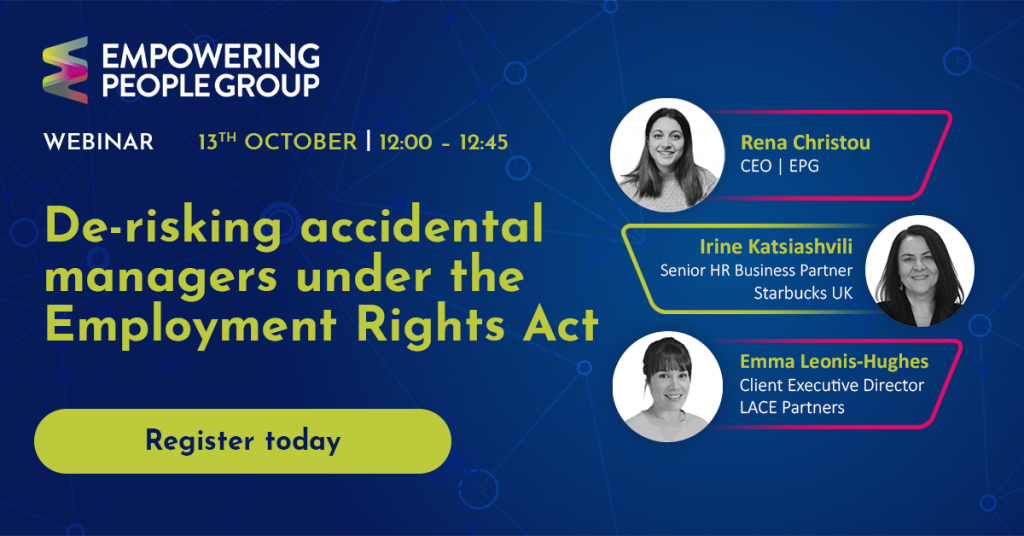
Join Rena Christou, Group CEO and practising Employment Lawyer, Irine Katsiashvili, Senior HR Business Partner at Starbucks UK, and Emma Leonis-Hughes, Client Executive Director at LACE Partners, for a practical discussion on what needs to change.
We’ll look at the issue from three angles: the employment law risk, what stronger manager capability looks like inside a major employer, and how HR operating models need to adapt to give managers more ownership without losing oversight and control.
We’ll cover:
- Why the ERA changes the risk profile of your managers – exactly where everyday management decisions are more likely to create legal, financial and reputational problems.
- What stronger manager capability looks like in practice – including how Starbucks UK has used better manager support and workforce insight to reduce absence.
- Why six months isn’t as long as it sounds – what the new unfair dismissal qualifying period means for recruitment, probation, performance management and early decisions about new hires.
- Where managers should self-serve (and where they shouldn’t) – giving managers the confidence to deal with straightforward people issues while making sure the right cases reach HR or legal support quickly.
- How data gives HR earlier visibility – spotting patterns, identifying where managers need support and intervening before problems become expensive.
- What the HR operating model needs to look like next – bringing together capable managers, self-service, specialist HR support, and clear escalation to legally privileged advice.
If your managers are being asked to take greater ownership of people decisions, this session will help you work out whether they, and the HR model around them, are ready for it.